

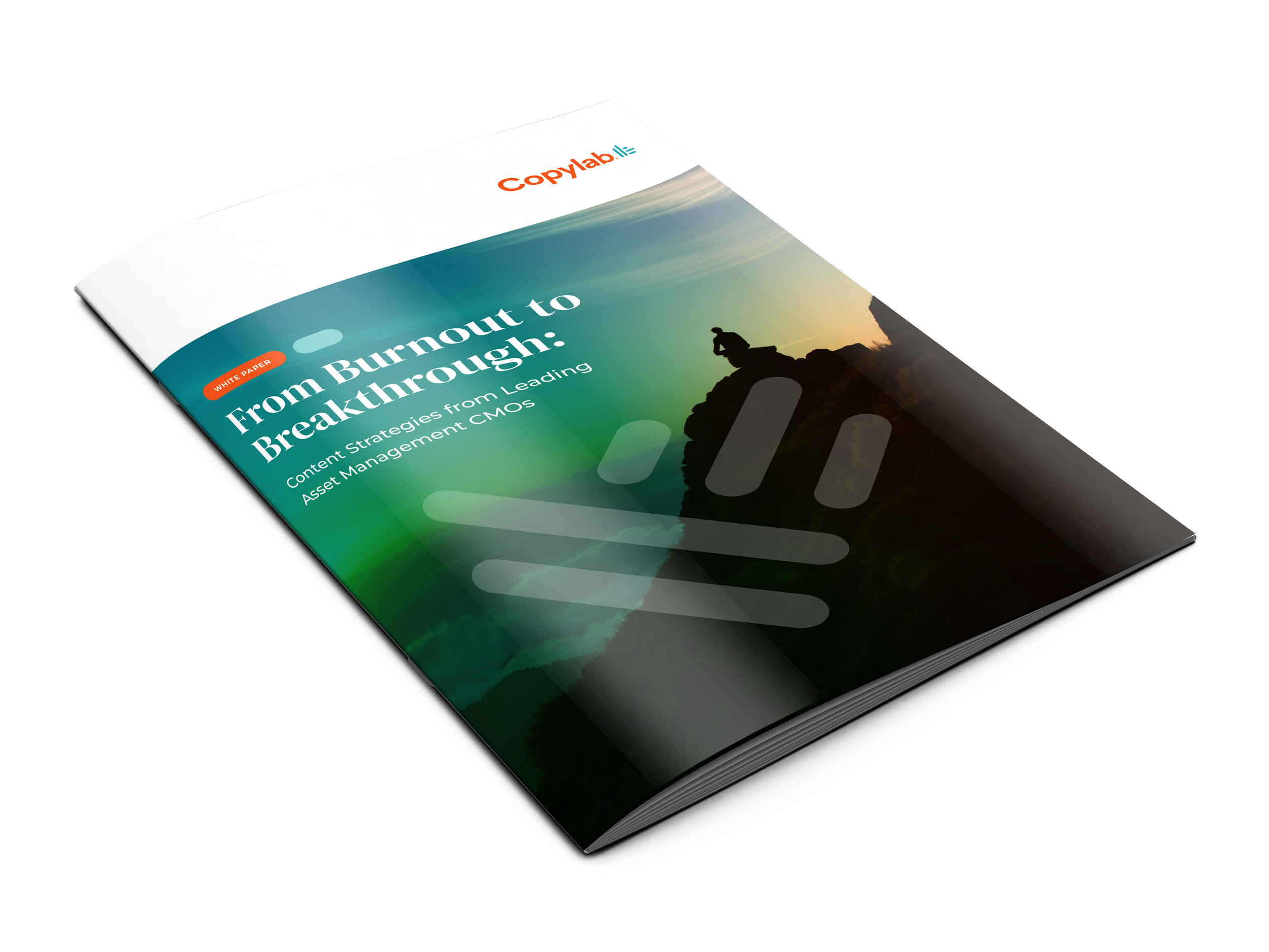
From Burnout to Breakthrough
Content Strategies from Leading Asset Management CMOs
By Linda Pixley
Senior Investment Writer, Copylab
Insights from leading financial marketers on balancing impact, efficiency and innovation
Marketing teams in asset management and other financial services face a massive challenge. Content expectations keep climbing – while budgets stay flat and bandwidth gets stretched thin.
At the same time, these teams must navigate shifting business priorities, input from multiple stakeholders and unpredictable demands from sales or investment leadership. Long-term planning is critical, but so is the ability to pivot quickly when market events or client conversations call for a timely response.
For many firms, balancing evergreen programs with opportunistic content has become a strategic juggling act. Add to that the pressure to demonstrate return on investment (ROI), the complexity of managing regional differences and the ever-growing range of formats to support, and it’s clear why many content teams feel stretched – almost to the point of burning out.
At Copylab, we hear this often, especially from our newest clients. Through our work providing writing, design and content-strategy support to leading investment firms around the world, we get a behind-the-scenes look at the challenges they face – and the strategies they implement.
Over time, we’ve observed subtle shifts. Asset-management marketing teams are evolving mindsets, streamlining processes and being deliberate about what they create – and how they create it. Whether it’s content governance, KPIs, AI tools or modular design, asset management marketers are reengineering their approach to not only meet the moment but get ahead of it.
Every team faces unique pressures, but one goal unites them – building a content engine that’s efficient without being inflexible and delivers impact without sacrificing quality, creativity or control. In this paper, we share the emerging strategies many of the industry’s top performers use to achieve this goal.
Strategic scaling: Doing more with less
One of the clearest themes emerging from today’s financial marketing leaders is the shift away from sheer volume. As internal demands grow and resources remain tight, firms are reevaluating what deserves to be produced and what doesn’t. Instead of indiscriminately pushing out content across every channel and product, leading teams align their content strategies to a narrower set of business priorities.
That shift requires asking tough questions:
Which content formats support client engagement?
Which pieces contribute to sales conversations?
Which efforts are simply legacy habits?
In response, many firms are concentrating their resources on core, high-impact content – flagship thought leadership, strategic product campaigns or advisor support tools – and paring back on the rest. Others are refining their evergreen content libraries to reduce, rework and repurpose existing insights more efficiently.
Equally important is right-sizing the format mix. Where once a 20-page white paper was the default, firms are increasingly shifting to modular content, short videos and flexible frameworks that can be adapted quickly for different channels or client segments. But the goal isn’t necessarily to produce less. It’s to produce better, more usable content that performs.
This kind of strategic scaling requires close collaboration with sales and product teams to understand what’s used (and what isn’t). For some, it also means embedding content teams earlier in the planning process to shape strategy rather than respond to it. Copylab, for example, often works with teams to identify where content is truly adding value, streamline what gets created and build flexible formats that can be reused across channels.
Personalisation at scale:
Balancing customisation with efficiency
For many asset managers, personalisation is now a baseline expectation, not just a “nice-to-have.” This is especially true for institutional and advisor-facing channels. Clients want content that speaks directly to them – by role, by region, by investment philosophy. And marketers are under growing pressure to deliver it, fast.
This is easier said than done.
Basic personalisation, such as name inserts or content tailored by client segment, is now standard. But more sophisticated customisation remains a heavy lift. Localising insights for different geographies, adjusting tone and content for various audiences and creating different versions for multiple channels still demands significant manual effort.
To tackle this, some firms are adopting modular content strategies. A central team might produce a core article or video, which is then adapted by regional or channel-specific marketers. This approach enables efficiency without sacrificing relevance. But it depends on having the right templates, guardrails and workflows in place.
Other firms lean more heavily on their sales teams, who act as de facto curators – assembling content on the fly to suit client conversations. It’s a creative workaround, but it raises concerns about brand consistency, messaging control and compliance.
A few firms are piloting personalisation tools to automate some of this process, but adoption is uneven. Technology alone doesn’t solve the problem, especially when marketing technology stacks are aging or disconnected.
Smarter use of generative AI and automation
Few topics have dominated marketing conversations over the last few years as much as generative AI. Whether it’s executive pressure to “test something” or team-wide experiments with using AI to summarise, rewrite or create content, the approach to AI has quickly gone from curiosity to capability. But while its promise is real, so are its limits. The smartest marketing teams are navigating both with care.
Of the firms we partner with, the most successful applications of AI tend to be targeted and tactical. Teams use AI tools to summarise lengthy internal documents, write or translate simple content or generate versions of original content. This accelerates routine production and frees up time for writers to focus on more strategic work.
One team uses AI to extract key takeaways from webinars and turn them into short-form content. Another trains tools to write alt text for charts and tables, streamlining accessibility reviews. Yet another is building prompts to help their sales teams version core messages by client type or channel.
These efforts all share one trait. A human controls, reviews and adjusts (as needed) the output, every time.
Of course, not everything goes smoothly. AI-generated content still struggles with accuracy, especially when working with complex financial data. Some tools fall flat on brand voice. Others introduce compliance concerns, particularly when integrated with open-source models. And despite all the hype, no one we’ve spoken to is handing over creative control.
Instead, firms are focusing on incremental gains. Some are training internal “super users,” people who understand both the content and the technology, encouraging them to experiment and share what works. Others are exploring closed-loop models that protect sensitive information while improving consistency and control.
The bottom line? AI isn’t replacing marketers. It’s becoming another tool in their kit. When paired with strong oversight and clear use cases, AI can reduce friction and increase output. But like any tool, it’s only as effective as the person using it.
That’s why expert writers – either internally or via external partners like Copylab – are critical. Producing great financial content with AI requires an understanding not only of the subject matter but also of the difference between quality writing and AI-generated fluff.
Breaking silos: Cross-team collaboration and governance
One of the biggest barriers to smarter content strategy is alignment. Even the most sophisticated firms struggle to bridge the gap between investment, sales and marketing teams. Priorities aren’t always in sync. Timelines conflict. And without a shared framework, content efforts can become reactive, repetitive or disconnected from the business goals they’re meant to support.
To counter this, many firms are investing in stronger governance. Some have formal editorial committees that include marketing leads, client-facing teams and senior investment professionals. These groups help set content themes, approve priorities and surface regional or channel-specific needs that might otherwise get lost. Others use quarterly planning meetings to coordinate around known events (such as central bank meetings or product launches) while building in flexibility for market-driven content.
In practice, this is where an external partner can help connect the dots. Copylab often works with teams across marketing, investment and sales to bring structure to planning, align priorities and shape content that’s consistent, relevant and easier to execute.
Governance also helps with execution. A clear content calendar that’s owned and updated by a cross-functional team can reduce duplication and manage stakeholder expectations. Many firms also integrate past performance metrics into these planning conversations, making it easier to evaluate which pieces are likely to earn their place on the calendar.
Meanwhile, others are exploring two-way models, such as global editorial frameworks that define broad strategic themes, paired with local or business-line autonomy to tailor content within that structure. This allows for consistency without rigidity and supports relevance across different audiences and markets.
Formats that work: Rethinking the content mix
Across the industry, firms are re-examining not just what they say but how they say it. Format strategy is now a core part of content planning, especially as attention spans shrink and new channels emerge.
The shift is most noticeable in video. Some firms now split their video strategy into two streams:
High-level thought leadership for broad distribution
Ultra-short clips crafted for sales teams to drop into client emails or LinkedIn posts
Others built in-house studios to streamline production, empowering marketers to film quick updates without a full crew. There’s growing experimentation with LinkedIn-native content, animated explainers and mobile-first formats.
It isn’t just video getting attention. Podcasts continue to gain traction. In some firms, podcasting has become a fast, scalable way to capture timely views without overburdening internal writers. Others repurpose video audio into podcast form, extending the life and reach of a single asset.
Format choice is more about performance than creativity. More firms use data to guide content investments, studying what formats actually engage their target audiences. One team discovered its blog posts consistently outperformed the podcast version of the same content. Another found teaser videos drove more traffic to long-form insights than emails.
The common thread is flexibility. Leading firms are building format strategies that adapt to different goals and distribution channels. One insight could be delivered as an article, a video snippet and a LinkedIn carousel. Each version is designed for how and where it will be consumed.
The takeaway is clear. Format strategy is no longer a finishing touch. It’s a key part of delivering the right content, in the right way, at the right moment, to the right audience.
KPIs that matter: Redefining content success
As marketing teams face rising pressure to prove their value, the way they measure success is evolving. It’s no longer enough to report only on page views or impressions. The most effective teams now focus on engagement, usage and alignment with strategic goals.
That shift starts with marketing teams asking better questions. Are sales teams using the content in the field? Are clients spending time with it or bouncing after the first few seconds? Did the campaign support a business priority or just fill a calendar slot?
To answer those questions, firms are building more nuanced KPI frameworks. Some track content performance by format and platform, comparing long-form articles, videos and podcasts across engagement metrics. Others monitor internal adoption, looking at how frequently advisors or wholesalers share specific assets. A few firms tie content directly to business themes, assigning red-amber-green ratings based on how well each piece supports their strategic priorities.
In some cases, metrics are now embedded in performance reviews. One team has quarterly article production targets, as well as deadlines for commentary approval and usage goals for sales enablement materials. Another is experimenting with “quality traffic rate.” This is a custom metric that blends meaningful clicks, completion rates and downstream actions.
Still, challenges remain. Integrating data across platforms is tricky. Educating stakeholders on how to interpret and act on marketing data takes time. And there’s always a risk of focusing too much on what’s easy to measure rather than what truly matters.
Ultimately, the firms leading in measurement are the ones building feedback loops, connecting insights back to planning and using performance as a guide, not a grade.
The role of partners: Scaling strategically with the right support
Even the most well-resourced marketing teams have their limits. When deadlines converge, internal requests spike, a team member leaves or new content needs emerge without warning, the question isn’t whether to bring in help – it’s which partner can add the most value.
For many asset managers, the answer has shifted. The right external partners are no longer just an extra pair of hands. They’re extensions of the team, playing a strategic role in helping marketing scale without compromising quality. The most effective partners are valued not only for what they deliver, but for how they work. They work alongside internal teams (in person or virtually), adapting to shifting needs and delivering clear, high-quality work.
Some firms lean on partners for specific, siloed tasks like design, writing or proofreading. Others rely on them for full content development – turning raw ideas into client-ready thought leadership, campaign materials or sales content. A few have established long-term relationships with partners who know their products, teams and brand inside and out. This enables the partners to jump in quickly and reduce internal workloads when needed.
Partners are also helping firms navigate technology shifts. From implementing AI tools to creating versions of modular content across channels, experienced partners can offer both capacity and perspective – especially when internal teams are already stretched.
The key is finding partners who truly understand investment concepts, not just content production. Financial marketers need collaborators who bring subject matter expertise, editorial sharpness and an understanding of what it takes to communicate complex investment insights. When the stakes are high and the deadlines are tight, there’s no time for a learning curve.
The firms making the most of outside support treat partners like part of the team. With the right collaboration model, outsourcing reinforces the brand, helping internal teams move faster with more confidence.
Scaling smarter starts here
As content expectations continue to rise, asset managers face a pivotal shift. The playbook that worked five years ago – high volume, broad formats, rigid plans – no longer fits the pace or precision today’s environment requires.
Marketing leaders are rethinking what it means to scale. The most successful ones are making strategic choices – fewer but better formats, modular content that travels, workflows that flex and partnerships that truly support the team.
There’s no one-size-fits-all solution. But across our work with leading firms, one thing is clear. The content teams building lasting impacts evolve with intention, not just intensity. They’re not chasing every trend. They’re building systems that balance speed with thoughtfulness, reach
with relevance and innovation with consistency.
Copylab supports this evolution every day. As a trusted content partner to investment and financial services firms worldwide, we help marketing teams execute with creativity and accuracy – without overwhelming internal resources.
Copylab is here to help.
If you’d like to take your financial communications to the next level (or just bring in some helping hands now and then), Copylab’s expert financial writers and designers can make it happen. Contact us to learn more.